Brand Strategy

Leadership

The Art of Seeing

Why creativity, reinvention, and strategy all begin before thought

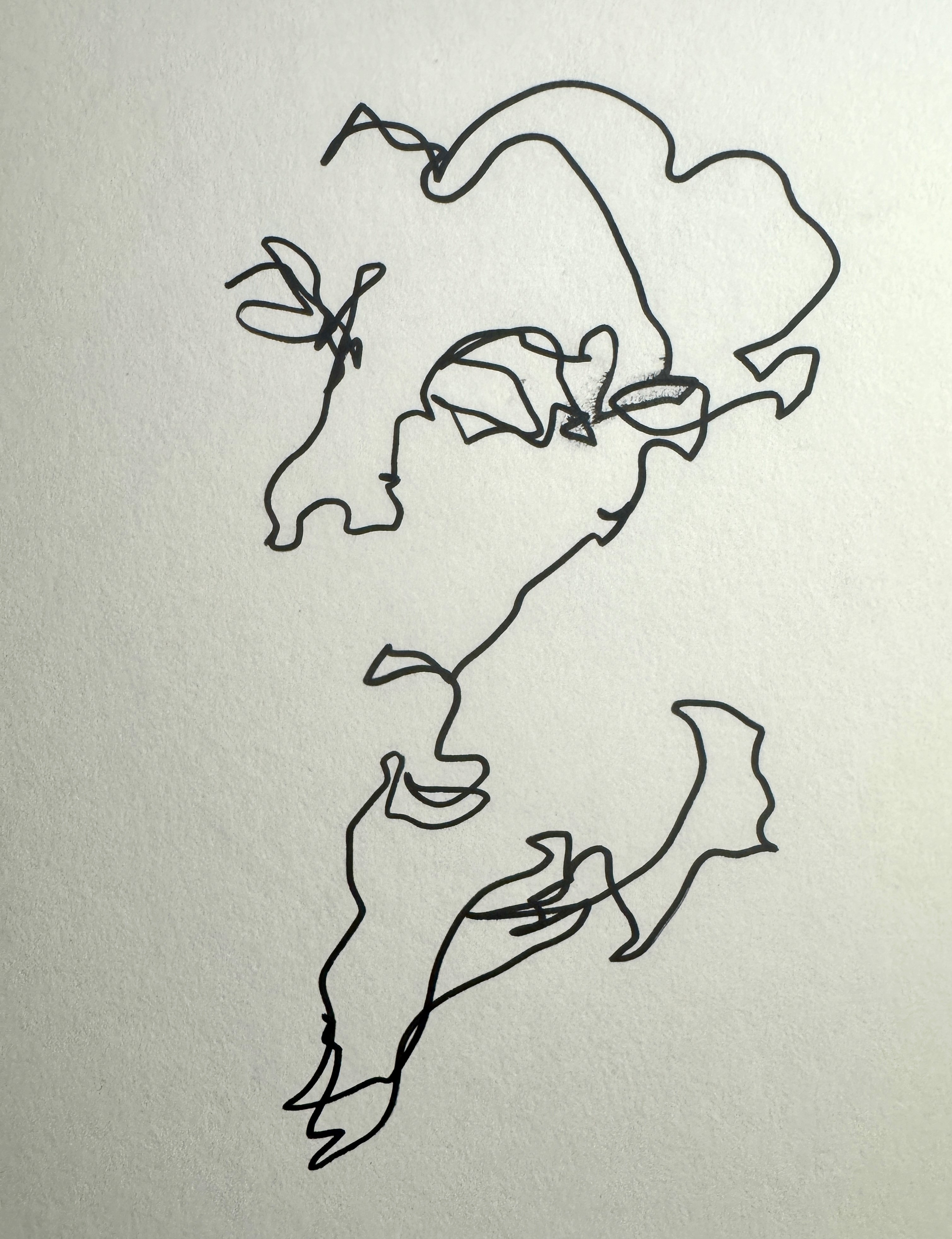
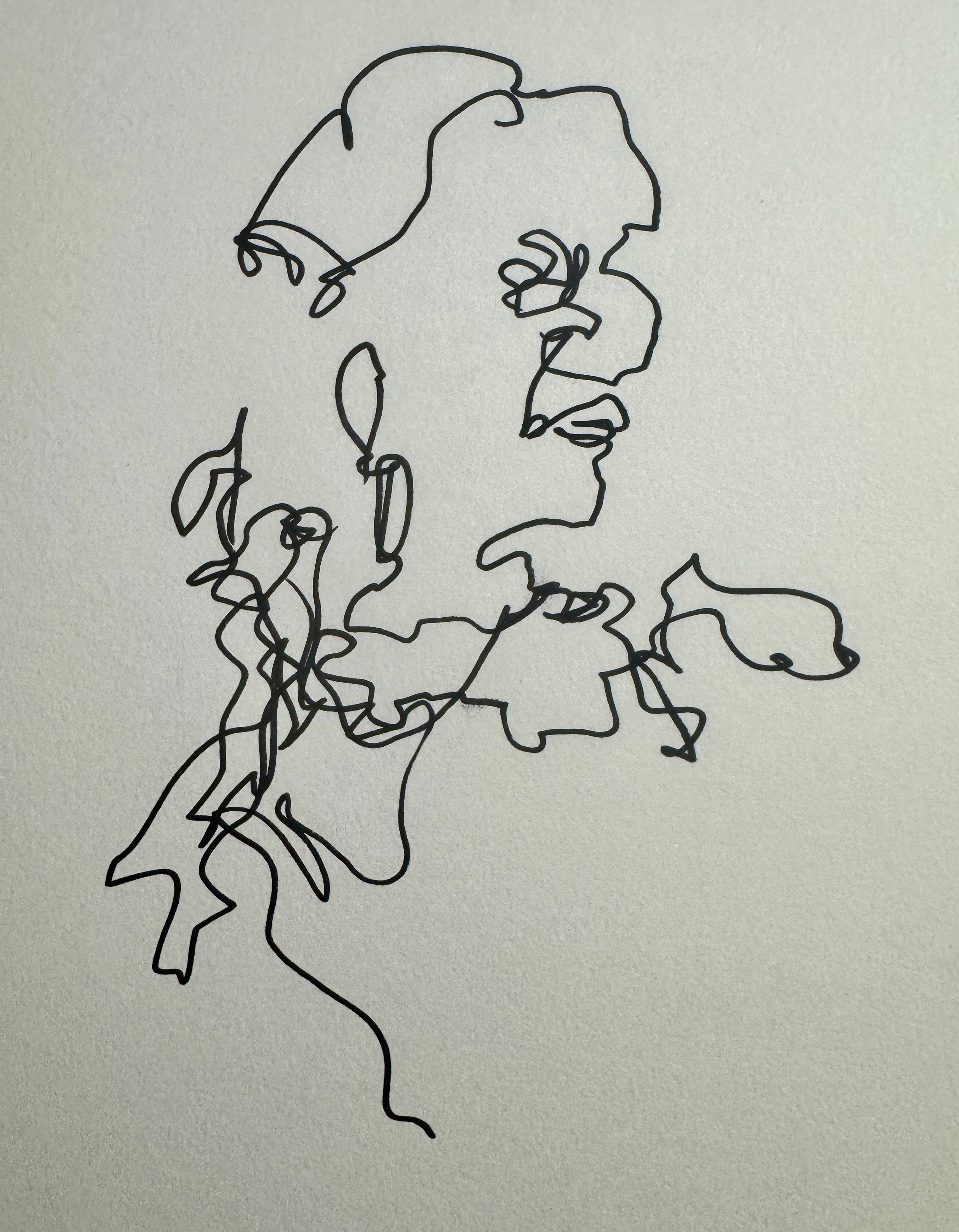
A blind contour drawing of a Second Harvest Summit participant

The Art of Seeing

Painting has taught me that most people don't see what's in front of them.

They see the label.

Tree. Leader. Brand. Success. Failure. Self.

Then they move on.

Painting and drawing interrupt that. They make you stay longer than your brain wants to stay. Long enough for the thing to stop being the category you placed it in. Long enough to realize how much more there is to explore when you remain present.

The label is not the thing

Some things are fine to take on face value. Challenging them gets you nothing.

But the things worth creating, the lives we are trying to grow into, often look obvious at first glance. It is only by learning to see differently that we discover what is asking for our more vulnerable attention.

Maps are efficient. So is labeling. We're wired for both. Millions of years of evolution trained us to build a world of categories and shortcuts because that's how you stay alive. You learn what is safe, what is dangerous, what belongs, what does not, what has worked before.

Efficient is not the same as creative. Expected is not the same as innovative.

Following the map gets you there faster. Going off-route is where the best stories and character-defining experiences come from.

That's why painting, and the creative process itself, matter so much to me. The practice of looking (outward and inward) is the only muscle I've found that keeps me from falling into what evolution programmed me to do automatically.

Creating art has never felt like control. It feels more like a willingness to converse and dance with the unknowingness of what is right in front of you: a landscape, a still life, an inner narrative, an emotion.

You may begin with an intention, but then the work starts talking back. The discipline is not forcing it to become what you planned. The discipline is staying awake enough to notice what it is becoming, and allowing yourself to follow as much as lead throughout the process.

That is also where creative work gets interesting.

Not when we execute the known answer cleanly, but when we can stay present long enough for the work to reveal something more true than the thing we thought we were making.

Creativity is one of the oldest ways humans have survived uncertainty. We imagine. Adapt. Improvise. Revise. Then, somewhere along the way, many of us are taught to trade that instinct for the safety of the expected answer.

It is why so much creative work and so many personal reinventions stop short of what they could be. The people behind them can't actually see what's in front of them, or find a way to move forward into something that feels undefined or unexpected.

Whether it's a brand that has been described the same way for ten years or an identity that no longer fits but keeps getting worn anyway, the gap is similar.

A workshop in seeing

Last month, I sat on the ground with a group of people at the Second Harvest Summit, held at the deCordova Museum outside of Boston.

Brand new blank sketchbooks open, markers in hand, I told them we weren't there to learn how to draw.

We were there to learn how to see.

Second Harvest Retreats, including the Summit, are run by Richard Banfield and Devon Warwick McDonald for people in some kind of transition. They've lost a job. They've exited a company they spent years building. They've lost a spouse. The kids have left for college. They've gotten divorced. Something that used to define them no longer does, and the next version of their life hasn't shown up yet.

Richard and Devon created Second Harvest for those gaps. The part where you know you can't keep holding onto the old identity, but you also can't see what's coming next. The part where you don't know which pieces of yourself to bring forward and which to leave behind.

That gap is terrifying.

Most people white-knuckle through it. They grab for the old identity even after it stops fitting, because the alternative feels too uncomfortable. Or they rush towards the next easily categorizable and expected situation so they can feel safe again.

Reinvention is hard because most of us are not changing from one clear self into another clear self. Reinvention is also hard because it is ultimately a solo journey, even when people help you along the way.

Most reinvention starts before we can explain it. First, there is discomfort, friction, even panic: a sense that the old shape no longer holds. Thinking usually arrives later, trying to justify what the body already knows.

I was there as a facilitator and a breakout session lead. The blind contour drawing workshop at the end of the day was mine.

We began with breathing. Eyes closed. Sitting on our blankets. Getting ourselves settled.

I told everyone in the group, "We've spent all day in language, words, stories, labels, structure. As we transition into this time together where we won't be using much language, I'd like you to consider the words that seem to have stuck with you as the day has progressed. When you open your eyes, write those words down on the very last page of your sketchbook."

Once we did that, I asked everyone to turn to the first page and destroy it.

Make a mess.

Scribble.

Feel how the different tips on the markers make different lines. Notice how the ink bleeds. Notice what fast lines and slow lines feel like. Notice what they look like.

This let us get over the preciousness of a blank sketchbook and the pressure of the first page. It warmed us up to begin.

I asked everyone to find something to focus on. It could be a tree, their own feet, a nearby sculpture, a structural object, whatever called their attention.

Then I encouraged them to let go of the labeling. The preconceptions of what a “good” drawing should look like. The imagined picture they thought they should be creating to convey it properly to a complete stranger.
Those were not our goals.

We were there to practice the art of seeing.

We focused our time on blind contour drawing. You look at the thing you're drawing, and you let your line follow your eye. You don't look down at the page to make adjustments. Your job is to feel how your eye moves and capture it with your pen.

I asked everyone to pay attention to where their eye entered the scene.

Just like you don't hear music all at once, you don't see everything all at once.

Your eye enters somewhere first.

Maybe it is pulled toward the contrast between light and dark. Maybe it lands on an internal detail, like the texture of bark on a tree. Maybe it follows the shape of an external line where an object intersects with its surroundings in a striking way.

Whatever it is, that becomes the rhythm you let your eye follow.

You pay attention to how fast or slow your eye moves. Where it jumps. Where it returns. Where it overlaps itself. Where it shifts into a different rhythm.

And throughout it all, you keep following with your pen.

These start as fast drawings, about two or three minutes each. No time to fuss or get hung up. No time to second-guess the next subject of your attention.

Toward the second half of the workshop, I had everyone partner up and draw each other. Seeing another person and being seen at the same time.

At some point in every one of these workshops, I end up saying this:

Nobody needs to see how perfectly or photorealistically you can draw a tree. They'd much rather sense how you were feeling the day you did the blind contour drawing of the tree.

Trust me on this. When you look back at drawings that came out of your own unique way of being in the world and seeing it, you will remember the way that day smelled. The people around you. The stories going on in your mind that you finally allowed to fall away so you could do nothing but be, and see.

That's the trap most people fall into the second they pick up a pen.

They start trying to make something that meets someone else's expectations.

Drawing a “good” tree.

Making the right marks.

Labeling everything so the picture matches what they think they're supposed to make.

It is the same trap that kills most creative work.

And the same trap that keeps people stuck in identities they've outgrown long after the identity stopped fitting.

Why the safe version always wins

We can't help it. We're built for it.

Betty Edwards wrote about this in 1979 in Drawing on the Right Side of the Brain. When you ask a grown adult to draw a tree, they don't draw what they see or feel. They draw the symbol for “tree” they developed when they were six.

That symbol got installed by the first few trees they really paid attention to, and it never updated.

The same thing happens with almost everything we know.

We install a symbol for what a leader looks like.

What a successful career looks like.

What a good life looks like.

Who I am.

Then we keep redrawing it for years. Most of us never go back to see whether the symbol still matches anything real or felt.

Iain McGilchrist has spent much of his work arguing that attention itself shapes reality. Some forms of attention narrow, name, categorize, and control. Others take in context, novelty, relationship, and the whole. We need both.

But professional life rewards the narrowing mode almost exclusively. We run meetings for it. We hire for it. We build brands by committee for it.

Then we wonder why everything starts to look the same.

Artists develop the other mode on purpose.

Most of us don't.

Now layer in the evolutionary piece.

Solomon Asch ran an experiment in 1951 in which he showed people lines of different lengths and asked which pair matched. The answer was obvious. But when a roomful of actors chose the wrong answer first, many test subjects went along with the group at least once.

They could see the right answer.

They picked the wrong one anyway.

Because dissenting from the group was dangerous for most of human history.

This is what kills novel creative ideas in committees.

Especially committees with no shared agreement on the creative mission, populated by stakeholders who are each individually scared to stand out.

Somebody in the room can see the new direction is more interesting. Maybe a few people can. Then someone senior says it feels risky. The room starts to agree, and the original perception gets buried under the conformity instinct.

The safe version ships.

The interesting version dies in a meeting.

It's also what keeps people stuck in transition.

The version of you that's trying to emerge doesn't fit the group's idea of who you are. The new identity feels risky to wear in public. So you keep performing the old one.

It isn't laziness. It isn't bad taste. It isn't failure of nerve.

It's the symbol system from age six, the narrowing mode doing the job it was built for, and a million years of evolutionary pressure rewarding the ones who went along with the group.

That is why seeing has to come before thinking.

Thinking is often the tool that built the trap in the first place.

You can't think your way out of a perception problem.

You have to perceive your way out of it.

Perception and exploration before strategy

So what does learning to see actually give you?

It trains you to explore the surface longer before you dive in. To get past the literal, flat, obvious version of whatever's in front of you. To ask more questions, more often, because you know the surface label is hiding something endless underneath it.

To trust that the underlying truth is worth digging for, and that the digging is the work.

This is true in brand work too.

The strategy does not always arrive fully formed before the creating begins. Sometimes the making is what exposes the strategy. The sketch, the conversation, the prototype, the wrong turn, the uncomfortable question. These are not distractions from clarity. They are how clarity emerges, how it is created.

The same is true in leadership. The same is true in reinvention. You do not always get to think your way into the next chapter from a safe distance. Sometimes you have to start looking, moving, making, and listening before you know what it means.

Velocity only matters if you are moving toward something true.

Otherwise, you are just accelerating the consensus.

The practice of seeing slows you down in the places that matter, so you can move faster once the truth is clearer.

It also lets you in on the joke: whatever you're looking at is not as fixed as it seems.

It's been shaped by your evolutionary brain, by every daily practice you've ever had, by the rooms you've been rewarded in, and by the unique perspective only you have because only you have lived your specific life.

Once you know your seeing is partial, your own point of view has room to actually emerge.

Until then, you're just rendering the consensus version of the world.

Every creative person has their own way of breaking through. What they have in common is the willingness to drop the symbol and look at what is usually unseen: the negative space around the subject, the shadows cast across it, the drama every subject possesses when examined deeply, and the feelings that emerge in the person doing the looking.

A tree drawn in deep grief will feel different from one drawn during a period of joy and freedom.

When we learn to see, something new always opens up.

The ideas come faster than you can write them down. The performance feels effortless, as if the conscious, managing mind has stepped aside and something more fluid has taken over.

Csikszentmihalyi called this flow.

Robert Henri wrote about it in The Art Spirit a hundred years ago. He called it the state that makes art inevitable.

This is the part most people are chasing without realizing it.

The feeling of being clear-eyed and connected enough to make something that wasn't possible the day before, but feels effortless in the making.

The practice of seeing is how you train for that.

Try it.

Find a tree. Don't draw the idea of the tree. Don't look at the page. Let your eye move and your hand follow.

The drawing probably won't look like a tree.

That's the point.

It may show you how much more there is to see and to feel.

At the very least, it will show you how to create something where there was nothing, a terrifying proposition for most adults, without needing to have it all figured out before you begin.

There's magic in there if you're willing to give yourself over to it, even for an afternoon outside a museum in Boston, surrounded by strangers, and somehow more yourself than you have ever been before.

541820 - MBE/DBE/SBE - Women Owned and Operated since 2008

© 2026 adeo. All Rights Reserved.

541820 - MBE/DBE/SBE - Women Owned and Operated since 2008

© 2026 adeo. All Rights Reserved.

541820 - MBE/DBE/SBE - Women Owned and Operated since 2008

© 2026 adeo. All Rights Reserved.